Availability: In Stock
AD620 Instrumentation Amplifier Module
$ 5.36
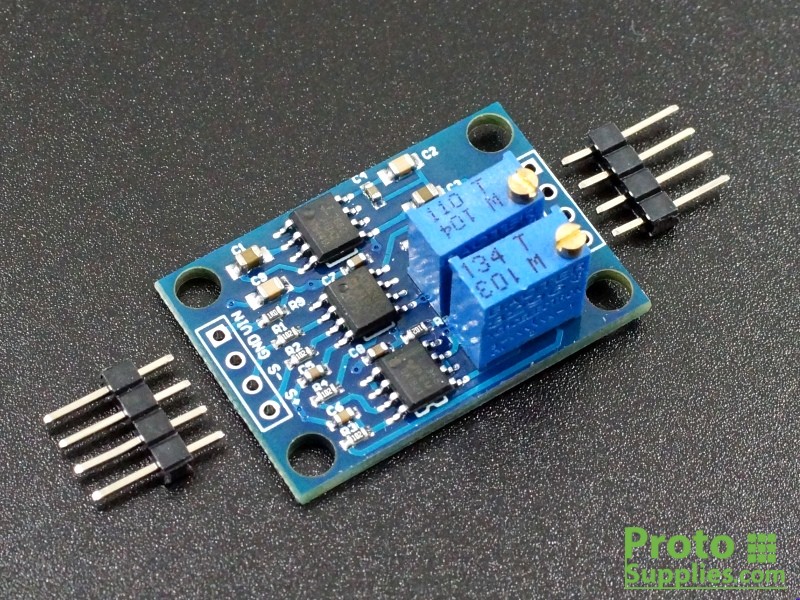
Description The AD620 instrumentation amplifier module provides a platform for amplification of small AC or DC signals from analog sensors, strain gauges, transducers and similar devices. PACKAGE INCLUDES: AD620 Instrumentation Amplifier Module 1×4 male header strips (x2) KEY FEATURES OF AD620 INSTRUMENTATION AMPLIFIER MODULE: Adjustable gain of 1.5 to 1000x Adjustable offset 120kHz bandwidth (gain = 100x) Input signal range of 100uV – 300mV Maximum output range of Vin – 2V 3.5-10V operation (Vin) The AD620 instrumentation amplifier module is handy for amplifying small AC or DC signals. As shipped, the module has some limitations which can be improved upon per our notes in the Our Evaluation Results section below. THEORY OF OPERATION: The module mounts an AD620A Instrumentation Amplifier IC along with a 7660 Voltage Converter IC, LM358 Op Amp and assorted resistors and capacitors. The module uses the AD620A version of the IC when referencing the data sheet. Module Power AD620 Instrumentation Amplifier Module Schematic The module can be powered from 3.5 to 10V on the VIN pin and adjacent GND pin. The VIN voltage passes through a 10 ohm resistor and connects to the Vs pin on the AD620. We denote this as V on our reverse engineered schematic. The 7660 voltage converter (charge pump) IC also takes in the V voltage and generates a negative voltage for the -Vs pin on the AD620 which we labeled as V-. This gives the AD620 both positive and negative power rails. V and V- also power the LM358 Op Amp The negative voltage is also brought out to the pin labeled V- on the output side of the board in case you want to tap into it. Do not connect this V- pin to ground or another voltage or the 7660 will be damaged. Module Amplification / Gain The module accepts an AC or DC input signal of between 100uV and 300mV. The signal is input on the S and S- pins. If the input is a ground referenced (single-ended) signal, the signal is connected to S and signal ground is connected to S-. Alternatively, a differential signal such as from a bridge sensor can be input across the S and S- pins. The inputs have a 1K series resistor to limit input current to a safe level. Gain of the AD620 is adjusted using a 100K potentiometer (marked 104). The advertised gain is 1.5x to 1000x and a lower resistance equals a higher gain. Turning the pot CW increases the gain. The output of the AD620 is passed through one of the two LM358 op amps configured as a unity gain buffer. The LM358 can source about 30mA and sink 20mA. The output of this buffer is available on the pin labeled VOUT. Zero Offset Adjustment The other half of the LM358 is also setup as a unity gain buffer to feed the Vref input of the AD620. The input of the LM358 has a 10K potentiometer (marked 103) and series 1K resistor tied between the V and V- power rails. The potentiometer adjusts the voltage input to the LM358 and the output is fed into the Vref pin on the AD620. This allows any offset to be adjusted out or if desired, a positive or negative offset can be adjusted in. Turning the potentiometer CW increases the offset in a positive direction. To set the offset, the S and S- pins are shorted together and the 10K zero offset potentiometer is adjusted until the voltage at VOUT measures 0V or the desired amount of offset. Module Connections The module has inputs on one end and outputs on the other. These can be used to connect wires or header pins can be soldered in depending on the application. 1×4 Input Header VIN = Module power (3.5 to 10V) GND = Ground for module power S- = Signal Input (negative connection) S = Signal Input (positive connection) 1×4 Output Header V- = Negative voltage output from 7660 GND = Ground VOUT = Signal Output GND = Ground The diagrams below show the basic connection setups for single-ended and differential inputs as well as the setup for adjusting the Zero Offset. OUR EVALUATION RESULTS: These are interesting modules with good potential and will work as-is for some applications, but as shipped, the module has some limitations which can be significantly improved upon if achieving optimum performance is desired. The main weakness of the module is due to using the 7660 charge pump IC to generate the negative voltage. Although this is convenient since it only requires one positive voltage to power the module, the electrical noise created by such a device creates more circuit noise than is desirable for an amplifier primarily designed to amplify very small signals. The 7660 is also subject to latch-up if it is driven at too high a voltage and so the module seems happiest in stock form when the VIN power is kept down around the 5V range. Add Bulk Capacitance to V- Ripple on the negative voltage output of the 7660 is the main offender. The circuit has a 0.1uf and 10uF capacitor to filter the negative voltage output. Adding additional bulk capacitance of 100uF or more significantly dampens the ripple on the output. One easy way to do this is to put a cap between the V- and GND pins on the output header location. Since the voltage is negative, if using an electrolytic cap, ensure the positive lead goes to GND and negative lead goes to V-. Add Bulk Capacitance to V A user of the module has shared that they achieved very good results by adding a 470uF electrolytic capacitor across V and ground on the 7660 by tacking it across C2. This helped to knock down ripple present on the positive supply. This was in addition to adding a large 2200uF capacitor on V-. Ditch the 7660 Altogether AD620 module with 7660 Removed If it is desired to get the best performance out of the module and you have a clean /- power source such as from linear regulators, one fairly easy hack is to simply remove the 7660 IC as shown to the right. You can then feed the external negative voltage to the V- pin along with the positive voltage fed to the VIN pin as normal. This also allows you to run a higher power rail of up to ±15V based on the maximum limitation of the LM358 of ±16V. The 7660 can either be unsoldered or the pins simply clipped off. The other components can all remain in place. The scope capture below is with the 7660 IC removed, power VIN and V- inputs set to ±12V and a 5mV 1kHz AC waveform input. The output maxes out at about 10.5V which gives a gain of 2000x. The small glitch was also present on the input signal. AD620 Instrumentation Amplifier Scope Capture 5mV 1kHz input Consider Changing the 100K pot The modules works well at lower gains, but at the highest gains, the resistance needed is approaching 50 ohms which is hard to get out of a 100K pot. If it is desired to work at higher gains, it would be beneficial to change the 100K pot to a smaller value one such as 10K or 1K to give better linearity at the lower end of the resistance range. We have gotten up to 2000x with the 100K pot in place, but the amplification adjustment is very coarse. Alternatively, if a fixed gain is desired, the pot can be replaced with a fixed value resistor in location R3 (Rgain) which is currently unstuffed next to the 100K pot. There is also a stuffed location also labeled R3 which should be left alone. The formula for calculating the resistor value is Rgain = 49.9K / (Gain – 1). For a fixed gain of 100x, the resistor value would be 49900 / (100-1) = 499 ohms. The data sheet has a table of commonly used values. BEFORE THEY ARE SHIPPED, THESE MODULES ARE: Basic zero offset functionality tested and adjusted for 10x amplification using 200mVAC input. Packaged in a resealable ESD bag for protection and easy storage. Notes: None Technical Specifications Operational Ratings Vcc Range 3.5-10V (VIN pin) Current Max Sink Current 20mA Max Source Current 30mA Bandwidth Gain = 100 120kHz Input Signal Range 100uV – 300mV Input Signal Type AC or DC Amplification Range 1.5 – 1000x Output Voltage Max VIN – 2V Offset Voltage Typical / Max 30uV / 125uV Input Bias Current Typical / Max 0.5nA / 2.0nA Offset Voltage Drift Max 1uV / degree Common Mode Rejection Ratio Gain = 10 100dB Dimensions PCB (L x W) 32 x 22mm (1.3 x 0.87″) Country of Origin China Datasheet Analog Devices AD620